用 AWS CDK 编排 SageMaker AI 端点自动扩缩容
Orchestrating SageMaker AI endpoint auto scaling with AWS CDK
AI 导读
通过 AWS CDK 自定义资源可在 SageMaker AI 端点更新时自动完成自动扩缩容的注销与重新注册,实现端点配置与扩缩容参数的单次部署、无需人工干预。
摘要与补充说明
原生 CloudFormation 方案下,端点配置变更会因可扩缩目标仍处于注册状态而被 SageMaker AI 拒绝;手动注销后再部署则可能静默丢失自动扩缩容,或在修改扩缩容参数时因 ScalableTarget 资源不存在而失败,且回滚失败会让堆栈进入需人工恢复的状态。
正文· AI 翻译
更新 Amazon SageMaker AI 实时端点配置(更改实例类型、实例数量或环境变量)会导致通过 AWS CloudFormation 或 AWS Cloud Development Kit(AWS CDK)进行的部署失败。SageMaker AI 要求您在更新端点之前注销可扩展目标,但注销后,CloudFormation 无法跟踪 AWS Application Auto Scaling 资源。
在本文中,我们展示如何使用可复用的 CDK 构造与 AWS CloudFormation 自定义资源,在端点更新期间自动编排注销和注册自动扩缩。您可以在单次部署中更新端点配置和自动扩缩参数,无需人工干预。
问题为何发生
当您使用原生 CloudFormation 自动扩缩资源部署 SageMaker AI 端点,然后更改端点配置并重新部署时,会出现多种失败模式。具体失败取决于您更改的内容以及采用的规避方式。
在自动扩缩已注册的情况下更改端点配置
CloudFormation 尝试在可扩展目标仍处于注册状态时更新端点。SageMaker AI 会拒绝该更新并返回以下错误:
The variant(s) "[AllTraffic]" must be deregistered as scalable targets with Application Auto Scaling before they can be removed or have their instance type updated.SageMaker AI 在 CloudFormation 到达自动扩缩资源之前就阻止了端点更新。
手动注销自动扩缩,然后仅更改端点配置
如果您通过 AWS Command Line Interface(AWS CLI)注销可扩展目标,并仅以端点配置更改重新部署,部署会成功。但是,尽管自动扩缩存在于 CloudFormation 模板中,CloudFormation 并不会注册它。由于 CloudFormation 模板中的自动扩缩参数没有变化,CloudFormation 不会注册可扩展目标,也不会重新应用扩缩策略。此时端点在没有自动扩缩的情况下运行,而且没有任何错误表明出了问题。
手动注销自动扩缩,然后更改自动扩缩参数
如果您通过 AWS CLI 注销可扩展目标,并以自动扩缩参数更改重新部署,CloudFormation 会尝试更新已不存在的 ScalableTarget 资源:
Resource of type 'AWS::ApplicationAutoScaling::ScalableTarget' with identifier 'endpoint/<name>/variant/AllTraffic|sagemaker:variant:DesiredInstanceCount|sagemaker' was not found.这一失败值得注意,因为回滚也会失败(UPDATE_ROLLBACK_FAILED),使堆栈处于损坏状态,需要在 CloudFormation 控制台中手动干预才能恢复。
解决方案概述
您可以使用此 CDK 构造,将原生的 AWS::ApplicationAutoScaling::ScalableTarget 和 AWS::ApplicationAutoScaling::ScalingPolicy CloudFormation 资源替换为三个自定义资源。这些自定义资源在端点更新前后执行注销和注册自动扩缩,并通过 CDK 中的 node.add_dependency 调用强制实施显式依赖顺序。完整顺序如下:
- 注销(自定义资源):在端点更新开始前移除可扩展目标。首次部署时尚不存在可扩展目标,因此处理程序会妥善处理该错误并继续。
- 端点更新(由 CDK 管理):CDK 正常更新端点资源,切换到新的端点配置。
- 注册可扩展目标(自定义资源):等待端点达到
InService状态,然后注册可扩展目标。 - 附加扩缩策略(自定义资源):等待可扩展目标可查询,然后应用目标跟踪策略。
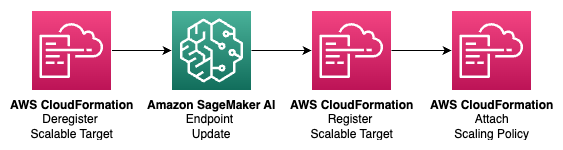
图 1:围绕 CDK 管理的端点更新,对 SageMaker AI 端点自动扩缩进行自定义资源编排。
Register Scalable Target 和 Attach Scaling Policy 使用 CDK provider 的异步完成模式。每个自定义资源都有一个 on_event 处理程序,它会立即返回,还有一个 is_complete 处理程序。provider 的 waiter 会按固定间隔(每 30 秒)重新调用 is_complete 处理程序,直到其就绪检查通过。provider 的 total_timeout(Register Scalable Target 为 1 小时,Attach Scaling Policy 为 15 分钟)限定了等待时长,因此它不受任何单次 Lambda 调用超时的限制。
每个自定义资源上的 ConfigHash 属性会强制 CloudFormation 在配置值发生变化时重新调用 Lambda 函数。端点配置和自动扩缩参数一起定义,因为单个 ConfigHash 驱动自动扩缩编排。
虽然该 construct 定义了三个自定义资源,但部署的堆栈中包含的 Lambda 函数超过三个。每个自定义资源都由一个 CDK cr.Provider 支持,而 provider 框架会生成自己的辅助 Lambda 函数。同步 provider(Deregister)会增加一个框架函数。异步 provider(Register Scalable Target 和 Attach Scaling Policy)会增加三个(onEvent、isComplete 和 onTimeout),外加一个驱动 waiter 的 AWS Step Functions 状态机。因此,部署的堆栈包含三个自定义资源、两个 Step Functions 状态机和十二个 Lambda 函数。其中五个资源承载 construct 自身的处理程序代码(一个用于 Deregister,每个异步资源各有一对 on_event 和 is_complete),其余七个由 provider 框架生成。你不需要编写或维护框架生成的函数,但它们存在于堆栈中,在检查已部署资源时值得纳入考虑。
演练
在本演练中,你将使用提供的示例堆栈部署一个带自动扩缩的 SageMaker AI 端点,然后验证配置更新能否正常工作。
本演练包括以下步骤:
- 克隆仓库并安装依赖项。
- 配置端点和自动扩缩设置。
- 部署并验证。
- 测试更新。
源代码可在链接的 GitHub 仓库中获取。
先决条件
本演练需要以下内容:
- 一个具有 Amazon SageMaker AI、AWS Lambda、AWS Identity and Access Management(IAM)、Application Auto Scaling 和 Amazon CloudWatch 权限的 AWS 账户。
- 已安装 AWS CDK v2。
- Python 3.12 或更高版本。
- 用于 Python 依赖管理的 uv。
- Amazon Simple Storage Service(Amazon S3)中的 SageMaker AI 模型构件和 Amazon Elastic Container Registry(Amazon ECR)中的容器镜像,或 SageMaker AI 内置算法容器。
克隆仓库并安装依赖项
- Clone the repository:
git clone https://github.com/aws-samples/sample-sagemaker-endpoint-autoscaling.git cd sample-sagemaker-endpoint-autoscaling - Install dependencies:
uv sync
配置端点和自动扩缩设置
端点和自动扩缩设置一起定义在 config/config.yaml 中,因为单个 config_hash 驱动自动扩缩编排。对任一部分的更改都会触发完整序列。
使用你的值编辑 config/config.yaml:
endpoint:
  endpoint_name: "my-model-endpoint"
  image: "123456789012.dkr.ecr.us-east-1.amazonaws.com/my-model:latest"
  model_data_url: "s3://my-bucket/models/model.tar.gz"
  instance_type: "ml.m5.large"
  initial_instance_count: 1
  environment: {}
autoscaling:
  min_capacity: 1
  max_capacity: 10
  target_value: 100
  scale_in_cooldown: 600
  scale_out_cooldown: 120
端点参数映射到 SageMaker AI CreateModel 和 CreateEndpointConfig API。自动扩缩参数映射到 Application Auto Scaling RegisterScalableTarget 和 PutScalingPolicy API。
部署并验证
- Bootstrap your AWS environment if you haven’t already:
uv run cdk bootstrap - Deploy the stack:
uv run cdk deploy InferenceStack
CloudFormation 创建 SageMaker AI 模型、端点配置和端点,然后按顺序运行三个自定义资源以注册自动扩缩。
- Verify that the deployment registered the scalable target:
aws application-autoscaling describe-scalable-targets --service-namespace sagemaker --resource-ids endpoint/my-model-endpoint/variant/AllTraffic - Verify that the deployment applied the scaling policy:
aws application-autoscaling describe-scaling-policies
--service-namespace sagemaker
--resource-id endpoint/my-model-endpoint/variant/AllTraffic
测试更新
更改 config/config.yaml 中的某个值,例如将实例类型从 ml.m5.large 更新为 ml.m5.xlarge,然后重新部署:
uv run cdk deploy InferenceStack部署完成后,请验证自动扩缩容是否仍处于注册状态,并且已更新为最新值:
aws application-autoscaling describe-scalable-targets
--service-namespace sagemaker
--resource-ids endpoint/my-model-endpoint/variant/AllTraffic
与现有堆栈集成
如果你是从零开始或想要一个参考实现,请使用示例堆栈。如果你已有包含 SageMaker AI 资源的 CDK 堆栈,请直接使用该构造。
要与现有堆栈集成,请将 sagemaker_autoscaling/constructs/ 目录复制到你的项目中,并将该构造与你的端点资源一起添加:
import json
from sagemaker_autoscaling.constructs.sagemaker_autoscaling_construct import (
    AutoscalingConfig,
    SagemakerAutoscalingConstruct,
    SagemakerAutoscalingProps,
)

# Both endpoint and auto scaling values must be in config_hash so that
# a change to either triggers the auto scaling orchestration.
config_hash = json.dumps({
    "endpoint": {
        "image": "123456789012.dkr.ecr.us-east-1.amazonaws.com/my-model:latest",
        "modelDataUrl": "s3://my-bucket/models/model.tar.gz",
        "instanceType": "ml.m5.large",
        "initialInstanceCount": 1,
    },
    "autoscaling": {
        "minCapacity": 1,
        "maxCapacity": 10,
        "targetValue": 100,
        "scaleInCooldown": 600,
        "scaleOutCooldown": 120,
    },
})

SagemakerAutoscalingConstruct(
    self, "Autoscaling",
    props=SagemakerAutoscalingProps(
        endpoint=your_endpoint,  # your CfnEndpoint
        autoscaling=AutoscalingConfig(
            min_capacity=1,
            max_capacity=10,
            target_value=100,
            scale_in_cooldown=600,
            scale_out_cooldown=120,
        ),
        config_hash=config_hash,
    ),
)
该构造的工作原理
本节将介绍 SagemakerAutoscalingConstruct 的关键实现细节。
注销
Deregister 自定义资源会在端点更新之前调用 deregister_scalable_target。它会处理首次部署时不存在可扩缩目标的情况,即 ObjectNotFoundException:
def handler(event, context):
    resource_id = event["ResourceProperties"]["ResourceId"]
    if event["RequestType"] in ("Create", "Update"):
        try:
            client.deregister_scalable_target(
                ServiceNamespace="sagemaker",
                ResourceId=resource_id,
                ScalableDimension="sagemaker:variant:DesiredInstanceCount",
            )
        except client.exceptions.ObjectNotFoundException:
            pass  # No scalable target on first deploy
    return {"PhysicalResourceId": f"deregister-{resource_id}"}
该依赖关系在 CDK 中建立:
props.endpoint.node.add_dependency(deregister)注册可扩缩目标
尽管 CloudFormation 在更新被接受后就会将端点资源视为完成,但可扩缩目标只能在端点达到 InService 之后才能注册。Register Scalable Target 不会让单次 Lambda 调用阻塞等待,而是使用提供程序的异步完成模式。on_event 处理程序会立即返回,提供程序的等待器会每隔 query_interval 重新调用 is_complete 处理程序,直到端点处于 InService 状态。提供程序的 total_timeout(1 小时)限制的是等待时间,而不是任何单次 Lambda 调用的超时时间:
def handler(event, context):
    props = event["ResourceProperties"]
    resource_id = props["ResourceId"]
    endpoint_name = resource_id.split("/")[1]
    if event["RequestType"] == "Delete":
        return {"IsComplete": True}
    status = sm_client.describe_endpoint(EndpointName=endpoint_name)["EndpointStatus"]
    if status == "Failed":
        raise Exception("Endpoint in Failed state")
    if status != "InService":
        return {"IsComplete": False}
    as_client.register_scalable_target(
        ServiceNamespace="sagemaker",
        ResourceId=resource_id,
        ScalableDimension="sagemaker:variant:DesiredInstanceCount",
        MinCapacity=int(props["MinCapacity"]),
        MaxCapacity=int(props["MaxCapacity"]),
    )
return {"IsComplete": True}在堆栈删除时,on_event 处理程序会注销可扩缩目标以进行清理。
附加扩缩策略
在 RegisterScalableTarget 返回后,会有一个短暂的时间窗口,此时目标尚不可查询。Attach Scaling Policy 使用相同的异步完成模式:on_event 处理程序会立即返回,而 is_complete 处理程序仅在可扩缩目标可查询时才报告完成,此时它会应用该策略。提供程序的 total_timeout(15 分钟)限制的是等待时间:
def handler(event, context):
    props = event["ResourceProperties"]
    resource_id = props["ResourceId"]
    if event["RequestType"] == "Delete":
        return {"IsComplete": True}
    resp = client.describe_scalable_targets(
        ServiceNamespace="sagemaker",
        ResourceIds=[resource_id],
        ScalableDimension="sagemaker:variant:DesiredInstanceCount",
    )
    if not resp.get("ScalableTargets"):
        return {"IsComplete": False}
    client.put_scaling_policy(
        PolicyName=props["PolicyName"],
        ServiceNamespace="sagemaker",
        ResourceId=resource_id,
        ScalableDimension="sagemaker:variant:DesiredInstanceCount",
        PolicyType="TargetTrackingScaling",
        TargetTrackingScalingPolicyConfiguration=json.loads(props["ScalingPolicyConfig"]),
    )
return {"IsComplete": True}在堆栈删除时,on_event 处理程序会删除扩缩策略以进行清理。
清理
为避免产生未来费用,请删除这些资源:
uv run cdk destroy InferenceStack这会删除 SageMaker AI 端点、端点配置、模型、Lambda 函数、IAM 角色、由目标跟踪扩缩策略创建的 Amazon CloudWatch 告警,并注销可扩缩目标。
结论
在本文中,我们展示了如何使用可复用的 CDK 构造来自动注销和注册自动扩缩容,从而编排 SageMaker AI 端点更新。该构造使用三个 CloudFormation 自定义资源,并具有显式依赖顺序和 ConfigHash 属性,以在部署之间保持自动扩缩容不受影响。
要开始使用,请克隆 sample-sagemaker-endpoint-autoscaling 仓库并按照设置说明操作。该仓库包含一个可直接部署的示例堆栈,你也可以将该构造集成到你现有的 CDK 堆栈中。
有关 SageMaker AI 的 Application Auto Scaling 的更多信息,请参阅 Automatically scale Amazon SageMaker AI models。有关 CloudFormation 自定义资源的更多信息,请参阅 AWS CloudFormation User Guide 中的 Custom resources。
关于作者

Lauren Eterno
Lauren 是 Amazon Web Services 的副交付顾问,专攻 AI/ML。她与客户团队合作设计、构建、部署和扩展机器学习与生成式 AI 解决方案。她拥有 Case Western Reserve University 的数据科学与分析学士学位以及计算机科学硕士学位。